„Made in India, faked in China – $5bn loss“: Indian companies suffer from piracy in China

According to a recent report appearing in the Times of India, China has emerged as a major threat for branded Indian products. Some Chinese firms are reportedly producing counterfeit products of popular brands like Dabur and ITC and selling them with a „made in India“ tag in India and Africa. Apart from severe damage to brand reputation, the economic losses are estimated to stand at Rs. 22,528 crores (close to $ 5 billion).

See, the full report (January 1, 2012):
http://timesofindia.indiatimes.com/business/india-business/Made-in-India-faked-in-China-5bn-loss/articleshow/11325880.cms


“India – A Lead Market for Frugal Innovations? Extending the Lead Market Theory to Emerging Economies”

The Institute for Technology and Innovation Management at Hamburg University of Technology (TUHH) publishes a new working paper on the topic: “India – A Lead Market for Frugal Innovations? Extending the Lead Market Theory to Emerging Economies“. The paper is authored by Rajnish Tiwari and Cornelius Herstatt (Working Paper 67, January 27th, 2012).

Abstract
India has emerged as a vibrant and versatile source for cost effective, “disruptive innovations” of various varieties. Price-sensitive consumers in a large and growing market keep inducing firms to apply “frugal engineering” for creating affordable products and services without compromising excessively on quality. Because, as The Economist asserts: “Frugal does not mean second-rate”. Such innovations are characterized by high affordability, robustness, and “good enough” quality in a volume-driven market. Resource constraints motivate firms and entrepreneurs to think out-of-the-box. The trick lies in creating solutions that are able to circumvent given environmental constraints in a cost effective way. India’s large and enormously young population faced with limited budgets, but well-endowed with high aspirations, provides an ideal experiment ground for many firms. Solutions created for the Indian market are often suitable for other developing countries in Asia, Africa and Latin America that frequently face similar socio-economic conditions. In some instances they succeed even in developed country markets by enabling significant cost reductions. This emergence as a hub for “frugal innovations” possibly suggests a “lead market” role for India.
On the other hand, lead markets, as understood today, are characterized by high per capita income, great customer sophistication and high quality infrastructure. Such assumptions imply that lead markets, almost by default, can only exist in economically developed countries because only they can finance the development effort. Using two anchor-cases of product innovations aimed at price-sensitive segments in India we generate preliminary evidence to challenge some of the core assumptions of the “lead market” theory and propose that lead markets can emerge in developing countries too because market attractiveness (e.g. volume of demand, export possibilities) and technological capabilities are able to offset many other deficiencies. The supposed absence of customer sophistication is channelized into a challenge for supplier-side sophistication to design cost effective, “good enough” solutions (“low-cost, thin-margin”) that can meet the aspirations of consumers in a highly competitive market. In order to master this challenge companies need access to a competent and sufficiently large technical base with first-hand knowledge of the ground situation of targeted customer groups (“social capital”).
Keywords: Lead Markets; India; Frugal Innovations; Frugal Engineering; Disruptive Innovations; National Innovation System; Sectoral Innovation System.

Besuch aus Indien: Für die Forschung nach Harburg

Auszug aus: Hamburger Abendblatt, 5.12.2012

TU Hamburg-Harburg

Besuch aus Indien: Für die Forschung nach Harburg

Hamburg. Prof. Heinz Herwig ist voll des Lobes: Sein Gast sei „sehr engagiert, kreativ und vielseitig“; ein meisterhafter Theoretiker, mit dem sich philosophische Gespräche führen ließen – und der gleichzeitig immer den praktischen Nutzen wissenschaftlicher Ideen im Blick habe. Kurz: „Er ist einfach gut.“ Der so Gelobte sagt, er wolle seinen Horizont erweitern, seine „Unwissenheit überwinden“, wie er sich ausdrückt. Er, der Spitzenforscher, der schon in 15 Ländern geforscht hat.

Shripad Mahulikar, 43, kommt aus Indien, er ist zum vierten Mal zu Gast am Institut für Thermofluiddynamik der Technischen Universität Hamburg-Harburg (TUHH). Ein Jahr lang wird der Ingenieurwissenschaftler hier Studenten unterrichten und mit Institutsleiter Herwig über Wärmeübertragung in Mikrosystemen wie Computerchips forschen. Zehn wissenschaftliche Texte haben die beiden gemeinsam veröffentlicht, seit Mahulikar 2003 erstmals in Harburg forschte.

Der Inder steht beispielhaft für die Mischung aus Bescheidenheit, Offenheit und Ehrgeiz, mit dem Forscher seines Heimatlandes im weltweiten Wettstreit der Wissenschaftsnationen an die Spitze drängen.

[Weiter lesen auf abenblatt.de]

DESY cooperates with Indian research centre

Agreement opens up top-class light sources to the Indian science community

Today (21.12.2011), in the Hamburg City Hall, an agreement was signed in the presence of Hamburg’s Science Senator and Second Mayor Dr. Dorothee Stapelfeldt that defines Indian participation at the X-ray sources PETRA III and FLASH. With this, the contracting partners DESY and Saha Institute of Nuclear Physics (SINP, India) concretise a general cooperation agreement which was concluded in May this year during the visit of Chancellor Angela Merkel to India. For five years, more than 3500 hours of measuring time at DESY research facilities will be made available to Indian scientists for their own and for joint research projects with DESY. In return, India contributes with a total of 14 million euros to the construction of the PETRA III extension at DESY, the world’s most brilliant synchrotron radiation source.

Professor Helmut Dosch, Chairman of the DESY Board of Directors: “This is a classical win-win situation. Large-scale research always was a forerunner of international cooperation, and at our top-class light sources, we bring together extremely talented and dedicated scientists from India and Germany.” Professor Helmut Dosch, Chairman of the DESY Board of Directors: “This is a classical win-win situation. Large-scale research always was a forerunner of international cooperation, and at our top-class light sources, we bring together extremely talented and dedicated scientists from India and Germany.”

DESY’s modern synchrotron radiation source PETRA III and the world’s first free-electron laser for soft X-ray light FLASH offer unique research possibilities and a great potential for innovative scientific experiments. Therefore, they are extremely attractive for the well-developed and highly qualified science community of India. PETRA III, which took up regular user operation in 2011, currently provides 14 beamlines of highly-intensive X-ray light for research. From 2013 to 2014, the facility will be extended with two additional experimental halls, hosting another ten beamlines in total.

India is planning to build an own synchrotron radiation source of the third generation for high-energy photons; thus, the country is very much interested in training young scientists at the DESY experimental facilities.

Dr. Dorothee Stapelfeldt, Second Mayor and Senator for Science and Research: “I am very glad that the cooperation agreement between DESY in Hamburg and Saha Institute of Nuclear Physics (SINP) in Kolkatais now successfully concluded. Already for several years, Indian scientists and DESY have been working together. The next important step is to further intensify this cooperation and to offer Indian scientists the possibility to participate in nano and materials science experiments. Particularly nanotechnology will be one of the key technologies of the 21th century. Nanotechnology has the potential to find important technological solutions for the major social challenges of our times, for example in the field of energy supply and climate protection. I am sure that this agreement is advantageous for both parties and will offer many new insights.”

Furthermore, DESY and SINP are discussing whether there are possibilities for additional cooperation in the field of particle physics and accelerators’ instrumentation.

—-

Source: DESY press release dated 21.12.2011

DESY kooperiert mit indischem Forschungszentrum

Hamburger Spitzenlichtquellen für die indische Wissenschaftsgemeinde

Heute (21.12.2011) wurde im Hamburger Rathaus im Beisein der Hamburger Wissenschaftssenatorin und Zweiten Bürgermeisterin Dr. Dorothee Stapelfeldt ein Vertrag unterzeichnet, der eine indische Beteiligung an den Röntgenquellen PETRA III und FLASH festlegt. Die Vertragspartner DESY und Saha Institute of Nuclear Physics (SINP, Indien) konkretisieren damit eine Rahmenvereinbarung, die im Mai bei einem Indien-Besuch von Bundeskanzlerin Merkel geschlossen wurde. Indische Forscher bekommen für eigene und gemeinsam mit DESY durchgeführte Forschungsprojekte fünf Jahre lang jährlich über 3500 Stunden Messzeit an DESYs Forschungsanlagen zur Verfügung gestellt. Im Gegenzug beteiligt sich Indien mit insgesamt 14 Millionen Euro am Bau der Erweiterung von PETRA III, der brillantesten Synchrotronstrahlungsquelle der Welt bei DESY.
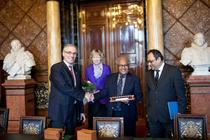
Prof. Helmut Dosch überreicht im Beisein von Hamburgs Wissenschaftssenatorin Dr. Dorothee Stapelfeldt ein Modell einer Beschleunigerstruktur an den Vorsitzenden des Wissenschaftsrats der indischen Regierung, Prof. C.N.R. Rao, und den Direktor des Saha-Instituts, Prof. Milan Sanyal (v.l.n.r.) Prof. Helmut Dosch, Vorsitzender des DESY-Direktoriums: „Wir haben eine klassische Win-Win-Situation. Großforschung war schon immer ein Vorreiter der weltweiten Zusammenarbeit, und wir bringen an unseren Spitzenlichtquellen äußerst talentierte und engagierte Wissenschaftler aus Indien und Deutschland zusammen.“

DESYs moderne Synchrotronstrahlungsquelle PETRA III und der welterste Freie-Elektronen-Laser für weiches Röntgenlicht FLASH bieten einmalige Forschungsmöglichkeiten und ein großes Potenzial für innovative, wissenschaftliche Experimente. Sie sind deshalb extrem attraktiv für die gut entwickelte Wissenschaftsgemeinde Indiens. PETRA III, die im Jahr 2011 den regulären Nutzerbetrieb aufgenommen hat, stellt zurzeit 14 Strahlführungen für hoch-intensives Röntgenlicht für die Forschung zur Verfügung. Von 2013 bis 2014 wird die Anlage mit zwei weiteren Experimentierhallen ausgestattet, die nochmals insgesamt 10 Beamlines beheimaten werden.

Indien plant selbst den Bau einer Synchrotronstrahlungsquelle der dritten Generation für hochenergetische Photonen und ist deshalb sehr daran interessiert, junge Wissenschaftler an den DESY-Experimentieranlagen auszubilden.

Dr. Dorothee Stapelfeldt, Zweite Bürgermeisterin und Senatorin für Wissenschaft und Forschung: „Ich freue mich sehr, dass es gelungen ist, diese Kooperation zwischen dem DESY hier in Hamburg und dem Saha Institute of Nuclear Physics (SINP) in Kalkutta zu vereinbaren. Bereits seit einigen Jahren arbeiten indische Wissenschaftlerinnen und Wissenschaftler und das DESY zusammen. Es ist ein wichtiger Schritt, diese Zusammenarbeit nun weiter zu vertiefen und indischen Wissenschaftlern nun auch die Möglichkeit zu bieten, sich mit Experimenten zur Nano- und Materialforschung zu beteiligen. Gerade die Nanotechnologie ist eine der Schlüsseltechnologien des 21. Jahrhunderts. Die Nanotechnologie hat das Potenzial, wichtige technologische Lösungsbeiträge zu den großen gesellschaftlichen Herausforderungen unserer Zeit, beispielsweise der Energieversorgung und des Klimaschutzes, zu leisten. Ich bin mir sicher, dass  die Vereinbarung für beide Seiten vorteilhaft sein und viele neue Erkenntnisse bringen wird.“

Weiterhin sind DESY und das SINP im Gespräch, um Möglichkeiten für weitere Kooperationen in den Bereichen Teilchenphysik und Instrumentierung von Beschleunigeranlagen auszuloten.

—-

Quelle: Pressemitteilung von DESY, 21.12.2011

Siehe auch eine Pressemitteilung des Hamburger Senats in der selben Sache